We’ve got quite an assortment from the fantasy blogosphere this week. From Scott Lynch news to an interview with Chris McGrath, the artist most famously noted for his Dresden Files cover art, it was a busy week:
Robin Hobb moves back into the top spot, and a new entry breaks the Amazon Top 5 Fantasy Bestsellers list this week. The Time Traveler’s Wife is a mixture os fantasy and sci-fi, that apparently touches upon all kinds of real world issues. Definitely worth checking out.
Random Saturday fun fact: You can get some really good new music, and contribute to a good cause at the same time. Check out the Mae 12 songs, 12 months project.
I first heard about Lamentation by Ken Scholes on the Dragon Page Cover to Cover podcast, where they hailed it as the most anticipated fantasy novel of 2009. A hefty title to ignore indeed. On my most recent trip to the States, I tried to locate the novel at a Barnes & Noble, a Borders, and finally at the Logan airport book store. The clerk at the airport book store looked it up online, and told me the book was not to be released until September.
Lesson learned: don’t trust airport book store clerks who very obviously go to Amazon rather than their own database and find the release of the mass market paperback. Here are some reviews:
Robin Hobb is nudged out of first this week by a vampire series, and Breaking Dawn moves up to sandwich Assassin’s Apprentice for the top 3 Amazon fantasy bestsellers. Vampires currently own 40% of the Amazon top 5:
Book review of Weis & Hickman’s Dragons of a Fallen Sun
Ah, Dragonlance. Dragons of Autumn Twilight was one of the very first non-choose-your-own-adventure-style novels I read, dating back to my pre-teen years. I’ve still got the original first printing paperback. Simply classic. Returning to Krynn is always a fun time for me, having read a healthy dose of Dragonlance in my life. I’ve made my way through the original Chronicles trilogy, the original Legends trilogy, Dragons of Summer Flame, The Dawning of a New Age, and more recently Dragons of the Dwarven Depths. I definitely dabbled in a few spin-offs as well, like Galen Benighted and the Preludes II books. The first six books I’ve read multiple times. So coming back to Krynn is always a bit nostalgic for me, but with that out of the way I can say I’ll be as fair as I can with this review.
For anyone who knows the Dragonlance world, Dragons of a Fallen Sun will be a welcome return. Everything you’re familiar with is here, from the non-human cast of elves, dwarves, kender, gnomes, draconians, minotaurs and the like to the warm feeling you’ll get when you return to Solace. The settings are some of the most well-known and well developed in fantasy books, and range from large cities to open plains to the underground tunnels of the dwarves and the forested protection of the elven lands.
Dragonlance novels are undeniably high fantasy. Dragons of a Fallen Sun is no different. You’ve got a fairly standard cast of rebel elves, conquesting dark knights, and mischievous kender. One of the main differences between this novel and the previous Dragonlance novels I’ve read is the presence of dragons. Dragons are seen in other Dragonlance novels, but they way in which they are presented as rulers over certain regions of Krynn in Dragons of a Fallen Sun differs from their typical appearances and presence in Krynn.
The novel moves fairly quickly, although one caveat I noticed is that at the beginning of a lot of the chapters, we’re reminded frequently of what the other characters are doing at that very moment. I personally don’t feel the need to be reminded continually of what else is going on in the novel. If I do forget (which can happen easily in books like A Game of Thrones), I’m usually delighted to return to a character I had let slip from my focus. Its actually a tool that some authors use to their advantage, and I felt that with Dragons of a Fallen Sun there was perhaps a bit of a “dumbing down” for mass audiences. I’m not sure if this is something Weis and Hickman would inject into their story themselves, or if it is a ploy of the publisher to appeal to a larger market. Either way, its there.
Even though this novel is set about 30 years in the future with respect to the original Weis and Hickman Dragonlance novels, they still manage to work three of the original eight characters from the Heroes of the Lance into the book. Its a difficult task to do for any author, but Weis and Hickman accomplish it beautifully in a manner that is at times funny.
Overall, while I thoroughly enjoyed my return to Krynn, there has been some opinion in recent years that the quality of the Weis and Hickman novels has declined. I had my first taste of this with Dragons of the Dwarven Depths, which is an even more recent book than Dragons of a Fallen Sun. It seems to me that there is a lack of enthusiasm on the part of Weis and Hickman with the recent Dragonlance books, and I would skeptically mention that it could be caused by Wizards of the Coast’s takeover of the Dragonlance books and the entire AD&D brand. Even though it brings me back to my childhood, I just can’t give high ratings to a book based on personal nostalgia, especially when it can’t compete with some of the other great fiction that’s out there right now from authors like Patrick Rothfuss, Scott Lynch, and Robin Hobb.
If you’re a Dragonlance fan, this book is definitely worth checking out, as there are a lot of familiar characters, settings, and stories. If you’re just getting started with fantasy novels, but would like to test the Dragonlance waters, I would suggest you start at the beginning with Dragons of Autumn Twilight.
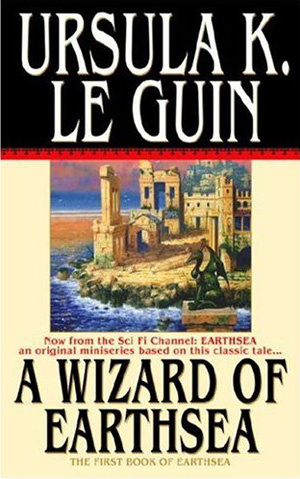
Book review of Ursula K. Le Guin’s A Wizard of Earthsea
I was given this book on loan, thanks to my great friend Rachel, as she thought it would be a good book for me to travel with. This was a very fitting selection, as the novel is filled with voyages into the unknown, the constant charting of new lands, and either chasing after, or running from, dreams or fears in life.
It was originally published in 1968, so I was expecting something akin to the style of The Sword in the Stone, which, even though it was written almost thirty years prior, in my mind seems to get lumped into a big ball of classics as does anything pre-1980. What I was delighted to find with A Wizard of Earthsea was not only a similar writing style to The Sword in the Stone, but also to beat generation novels like Jack Kerouac’s On the Road and The Town and the City. It seems that in the mid-nineteen hundreds a more free-form writing style was the popular practice, while today authors seem to take a much more refined, direct approach. But enough on theory.
Earthsea is an ocean littered with islands, some of which disappear with the tides. The people are wary of travelers, and what they know of the world consists of their understanding of their land, and the few stories they may have heard about other islands over the years, but even those seem distant dreams. There is an average cast of characters here, and it should be noted that I found many similarities between this novel and some of the character and plot aspects of The Name of the Wind. For instance, the main character goes to a school for wizards and meets who comes to be a rival on the first day of school. The magic system is similar in that the characters who truly learn to master different aspects of wizardry do so by learning the true names of things. Its really interesting to see how newer novels were influenced, sometimes more heavily than you realize, by some of the classic fantasy novels.
The pace of A Wizard of Earthsea is very brisk. The author moves from once situation to the next, only dwelling long enough to cover the essentials, without any unnecessary filler or padding. This makes for a very light novel (the paperback I have weighs in at 187 pages), one that does not set you down and give you a chance to rest. This does not result in a lack of quality reflection time. Le Guin covers everything from the responsibility that comes with great power:
Ged, listen to me now. Have you never thought how danger must surround power as shadow does light?
to the intellectual contemplation of nature:
From that time forth he believed that the wise man is one who never sets himself apart from other living things, whether they have speech or not, and in later years he strove to learn what can be learned, in silence, from the eyes of animals, the flight of birds, the great slow gestures of trees.
It is this ability to balance a fast-paced story with the beauty of pondering some of the finer aspects of life that makes A Wizard of Earthsea truly shine.
The most prominent and meaningful aspect of A Wizard of Earthsea is the underlying theme of the main character in a constant battle with himself, and the stark contrast of either running from your problems, or turning to face them head-on. It describes vividly how the way in which one decides to handle life issues can be either a blessing or turn into a disease. It is this concept that I believe makes A Wizard of Earthsea as timeless as it is. Just about anyone can relate to this sentiment on some level:
But as the day passed, his impatience turned from fear to a kind of glad fierceness. At least he sought this danger of his own will; and the nearer he came to it the more sure he was that, for this time at least, for this hour perhaps before his death, he was free.
It this modern world we live in it can feel at times as though we are locked eternally into a struggle to get ahead, but the real joy and happiness is found when we live in the moment, and realize that we are free to enjoy the time we are given as we please.
A Wizard of Earthsea is truly a book deserving of the title “classic”, and has rightfully earned its place upon my bookshelf for years to come. Or at least until I have to give it back.
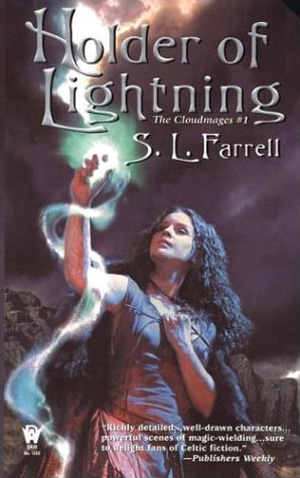
Prior to picking up Holder of Lightning, I was understandably skeptical, this being my first adventure in Celtic fiction. I decided to give it a chance only because S.L. Farrell was one of the authors recommended by George R.R. Martin in his latest update on the release date of A Dance with Dragons. I have in the past taken a liking to historical fiction, even if it was more Latin-based than Irish. Tigana by Guy Gavriel Kay was a tremendous book, with character and setting names deeply rooted in Italian and Latin. I may just have a tendency to lean in that direction however, having taken 4 years of French in high school and speaking Portuguese on a daily basis now, both Latin-based languages.
If using Irish-based language, characters and settings were the goals of Holder of Lightning, then they were accomplished in spades. I found myself saying a lot of the words out loud upon first read, just to get a sense of how they should sound. The book also contains rich appendices filled with language and culture definitions. You can’t say that Farrell didn’t do his homework.
There is a healthy dosage of magic in this book, even overdone at times. If you’re into more realistic historical fiction, I would caution you to stay away. The treatment of magic was eerily similar to the classic Raistlin Majere syndrome: character uses up magic reserves, must seek solace in herbal tea to recoup.
The settings are vast. From the small town beginnings, to high court intrigue, to a few sea and land voyages, Holder of Lightning has them all. While it was refreshing once Jenna, the main character, finally decided to set off on a cross-country journey about halfway through this roughly six-hundred-pager, it was refreshing only because the attempt at court politics preceding fell so bland. A lot of the plots were predictable, and the dialog fairly sub-par. When you’ve seen how multifaceted complex situations can shine in such novels as the Song of Ice and Fire series, the dialog in Holder of Lightning can only be judged as falling a little short.
Unfortunately the pace went hand in hand with the dialog issues. I felt the novel became stagnant until the characters decided to make a major setting shift about halfway through the book. The pace definitely picked up from the midway mark through the finish, but by that point I had lost some of my excitement and feel the second half didn’t do enough to make up for it.
There is a healthy cast of characters here, and this is where S.L. Farrell really shines. The character development, like the setting and world-building, is on par with any other genre fantasy novel. Like I stated, I haven’t read any other Celtic fiction, so I don’t have a good basis for comparison within this specific niche, but comparatively with other historical fiction this is a job well done. Unfortunately, as well defined as the characters are, they suffer from the aforementioned dialog issues, and I found a lot of their actions to be either somewhat predictable, and in some cases overdone and obvious.
One formatting issue I don’t like is when maps are interspersed throughout the text. I find that if I want to go back and look at a specific map, I’ll be flipping through page after page when I could have easily located the map if it were at the front or back of the book. I understand authors may not want to reveal certain maps until certain points are reached in the book, but I feel that in this case the map should be placed at the back of the book and some type of notification made either at the beginning of the book or referenced in the text as a footnote if making the reader aware of a certain map is that important to the flow of the plot.
Overall I think this is a healthy first shot at a historical fiction for S.L. Farrell. While there were certain areas like dialog and pace that could use a lot of improvement, there is definitely potential here that I believe, if the author is truly dedicated, could make the following novels really shine. Holder of Lightninig just had a rough time getting off the ground.
Book review of George R.R. Martin’s A Game of Thrones
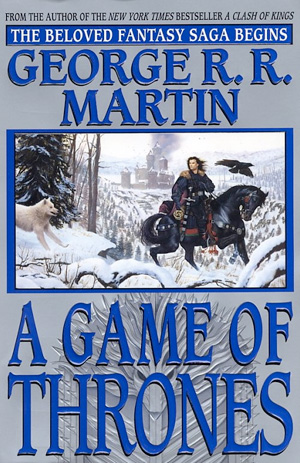
It’s not only a pleasure to revisit A Game of Thrones, the first book of George R.R. Martin’s A Song of Ice and Fire series, its somewhat of a necessity. With each edition of the growing series averaging between seven-hundred and one-thousand pages, and Martin going on four years between the release of the fourth and fifth novels, its getting a little tough to remember the details of the first novel which was released in 1996. And a growing series it is. The fourth and fifth novels were originally planned as one, but when they grew too large for Martin’s publisher to release as one edition, it was decided the fourth book would be split in two, pushing the total for the series from six books to seven. If you’re not a fan of truly epic fantasy, you can’t say I didn’t warn you: A Game of Thrones defines epic.
It’s also worth noting that for this revisit to the A Game of Thrones and the seven kingdoms, I’ve chosen to go the audiobook route. I find that an audiobook is the perfect format to revisit a book that I’ve already read. I don’t typically re-read books – there’s just simply too much good stuff out there – but an audiobook presents not only an alternative method (I can listen while working, for instance), but an entirely different creative presentation. Reader Roy Avers does a fantastic job of bringing the characters in A Game of Thrones to life, adding a new dimension to the novel, and resurrecting subtleties of character’s personalities that I may have missed the first time around. That said, this review is of the book itself, not strictly the audiobook.
George R.R. Martin’s A Game of Thrones is the quintessential genre novel. It breaks the once thought of boundaries of what an epic fantasy can and should be. Its got an ensemble of poignant moments, matched with robust dialogue. While thick and twice the size of some of the The Lord of the Rings novels, to set a basis for comparison, I was not once left feeling like the pace could be picked up a bit, as I was more than once during Tolkien’s series. While lengthy, every bit of the juicy story in A Game of Thrones is worth your time. Parents should beware, this is not a novel for the children, or the faint of heart. There are adult themes, and a few gruesome moments. However, Martin does not go into extreme detail when the opportunity presents itself.
Set in a world where the seasons are unbalanced, and it has been Summer for much too long, A Game of Thrones takes place on the brink of what the elders believe to be the long winter, which is approaching at a sluggish pace. This land has everything one could ask for in an epic fantasy, from the frost of The Wall and Castle Winterfell in the North, the islands in the East and the West, to the sun-streaked lands of Dorne in the South. Much of A Game of Thrones takes place in the uncharted Summer lands, where the Dothraki horse people roam free. The meat of the novel take place in the heart of Westeros, in the midlands, in the castles of the regal. If high court intrique is your taste, you’ll plenty here in A Game of Thrones.
While the characterization, dialog and setting development shine, the format of this novel is perhaps what is the most brilliant aspect of A Game of Thrones. Martin’s ability to write entire chapters from the point of view of such a vast variety of perspectives is what truly amazes me. He runs the gamut: the middle-aged “king in the north” faced with a proposition of a job upgrade versus more time with his family; his bastard son of fifteen; his wife, the confident, intelligent, strong woman; their son, a boy of nine; two of their daughters, twelve and ten; another thirteen year old girl; an imp; the list goes on an on. The dynamic of seeing a story from this many directions is compelling. The realism that is brought to a tale when an author can tell it in this fashion, and truly, and I mean truly, get into the skin of each of these characters, is something I doubt will happen ever again in fantasy fiction. A Game of Thrones is just simply unmatched.
The end product of an author having the ability to literally transform himself into so many well-established characters is a novel as multi-dimensional as A Game of Thrones. You begin to see the people in this world as real human beings with real problems and real beliefs. The story takes on not one, but a vast variety of plots and sub-plots, each of them more consuming than the next. The way the story lines diverge and inevitably cross paths again weaves a tale that is simply pure genius.
For this, I can give nothing but my best rating possible to A Game of Thrones. George R.R. Martin has truly given us a world and people worth believing. Isn’t this the reason we all started reading fantasy novels so many years ago?
 by Robin Hobb
 by Charlaine Harris
 by Naomi Novik
 by Stephenie Meyer
 by Audrey Niffenegger
 by Terry Brooks
 by John Birmingham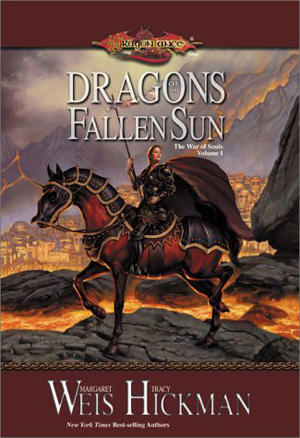



 It’s not only a pleasure to revisit A Game of Thrones, the first book of George R.R. Martin’s A Song of Ice and Fire series, its somewhat of a necessity. With each edition of the growing series averaging between seven-hundred and one-thousand pages, and Martin going on four years between the release of the fourth and fifth novels, its getting a little tough to remember the details of the first novel which was released in 1996. And a growing series it is. The fourth and fifth novels were originally planned as one, but when they grew too large for Martin’s publisher to release as one edition, it was decided the fourth book would be split in two, pushing the total for the series from six books to seven. If you’re not a fan of truly epic fantasy, you can’t say I didn’t warn you: A Game of Thrones defines epic.
 over at Amazon.com.
 Fantasy Book News
You must be logged in to post a comment.