Review: The Name of the Wind by Patrick Rothfuss

Book review of Patrick Rothfuss’s The Name of the Wind
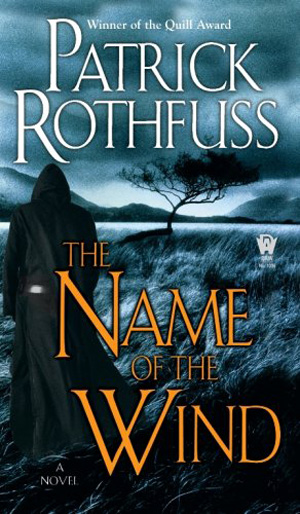
The Name of the Wind by Patrick Rothfuss

Before cracking open The Name of the Wind and reading one word, I had some pretty high expectations. This is supposed to be the series that eclipses The Lord of the Rings and redefines the genre. Patrick Rothfuss has been hailed as a master of the craft, and this is only his first venture into the genre. Generally, with hype of this magnitude, I’m almost unavoidably let down with the presentation. Kvothe has some pretty big shoes to fill.

This novel is of the epic high fantasy genre, and while its scope is rather grand, weighing in at 722 pages and set to span 3 books, the book is presented as a first-person narrative. If you’re not accustomed to this perspective of storytelling, you may want to be wary. However, how Rothfuss accomplishes this is creatively done to say the least.

The book is presented in a completely linear fashion. If you’re used to the constantly shifting perspective of a George R.R. Martin tale, the flashback-style of The Lies of Locke Lamora, or even the triple plot split of The Lord of the Rings series, you won’t find any of it here. The fact that Rothfuss could write a novel of this size, mainly from the perspective of one character, make it linear, and keep it as interesting as he does is a feat in itself.

And keep it interesting Mr. Rothfuss does. The pace is rather quick for a novel of this size. While Rothfuss is able to keep the pages turning, he writes in a extremely detailed and descriptive fashion. The settings are lavish, from the countryside to the city scenes to the University where the main charatcter Kvothe eventually finds himself. Where Rothfuss really shines is with his descriptive powers surrounding characterization. The details radiate in a circle out from Kvothe. I found his parents to be extremely well-developed, as well as his love interest and professors at the university. Even the bad guys get some fine treatment:

The voice came from a man who sat apart from the rest, wrapped in shadow at the edge of the fire. Though the sky was still bright with sunset and nothing stood between the fire and where he sat, shadow pooled around him like thick oil. The fire snapped and danced, lively and warm, tinged with blue, but no flicker of its light came close to him. The shadow gathered thicker around his head. I could catch a glimpse of a deep cowl like some priests wear, but underneath the shadows were so deep it was like looking down a well at midnight.

While the characterization is extremely well done, it is a bit concerning that the best descriptions seem to come with the characters that Patrick has probably dealt with in his own life.  Parents, your first love, teachers; these are all individuals that all of us have intimate experiences with and could probably do a decent job of transferring into a work of fiction.  It will be interesting to see how Mr. Rothfuss fares when taking his work in a different direction, by stepping into the minds of other characters, or dealing with characters that are not as easily identifiable to the average person.  This aside, the characterization accomplished in The Name of the Wind is a job well done.

The dialog is average, without too many stand out or memorable passages.  Like any great novel or work in any genre, The Name of the Wind is chock full of ideas and commentary that holds true in life.  This is possibly the most important part of fiction novels to me, as I feel that when I get to the end of a novel not only did I have a fun time getting there, but I’ve also got something to take with me and use later on in life.  Here are a few samples:

“Did you learn the whole language?”

“No. Of course not,” Kvothe said rather testily. “Only a portion of it. A large portion to be sure, but I don’t think you can ever learn all of anything, let alone a language.”

Toward the end of the summer I accidentally overheard a conversation that shook me out of my state of blissful ignorance. When we are children we seldom think of the future. This innocence leaves us free to enjoy ourselves as few adults can. The day we fret about the future is the day we leave our childhood behind.

Once I knew what the problem was, it was just a problem, nothing to fear.

And my favorite:

My parents danced together, her head on his chest. Both had their eyes closed. They seemed so perfectly content. If you can find someone like that, someone who you can hold and close your eyes to the world with, then you’re lucky. Even if it only lasts for a minute a day. The image of them gently swaying to the music is how I picture love in my mind even after all these years.

The novel also places a heavy value on music: how it gets into a person’s blood and can consume them; the details of the life of the musician on the road; all the aspects of the first performance.  I won’t spoil any of these moments here, but it can be comical in its truth at times:

A poet is a musician who can’t sing. Words have to find a man’s mind before they can touch his heart, and some men’s minds are woefully small targets. Music touches their hearts directly no matter how small or stubborn the mind of the man who listens.

Overall, I believe Patrick Rothfuss’ The Name of the Wind completely lives up to the hype, and takes it a step further by connecting personally with me on a musical and emotional level.  I found myself reflecting after closing its pages on how I wish I had got my hands on it as a teenager, prior to attending college.  I think this book would have totally changed my outlook, and I would have treated the overall experience of schooling and knowledge with more respect and reverence.  It was interesting transitioning from reading The Sword in the Stone, which is a novel about a single relationship between teacher and student, to The Name of the Wind which details one student’s extreme passion and desire for knowledge. That I’ll be returning for the next installation goes without saying. I can’t wait to see what happens when Kvothe’s past catches up with him.

You can purchase The Name of the Wind over at Amazon.com.
Fantasy Book News Ratings

  • Overall: 9 out of 10
  • Plot Originality
  • Setting Development
  • Characterization
  • Dialog
  • Inspiration/Deeper Meaning

Fan Ratings

Interview with Patrick Rothfuss on The Name of the Wind

Part 1

Part 2

Part 3

Categories: Patrick Rothfuss, Reviews, The Kingkiller Chronicle | Tags: , , , , | 3 Comments

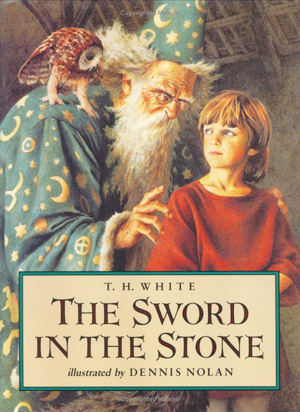
Review: The Sword in the Stone by T.H. White

Book review of T.H. White’s The Sword in the Stone

The Sword in the Stone by T.H. White

Its a bit strange reviewing a book whose original copyright date is 1939.  I was lucky enough to come across a copy of T.H. White’s The Sword in the Stone prior to starting The Once and Future King, which has been sitting on my shelf unread for over a year now.  The Sword in the Stone serves as a sort of prequel to The Once and Future King, detailing the schooling of a young King Arthur.  My only knowledge of the novel stems from the 1963 Disney movie, which I had seen when I was a child.  It may have been one of the first influences that steered me in the direction of a love for fantasy novels.

Leading up to starting The Sword in the Stone, this was my preconception: this is a child’s book.  While I still believe that this book firmly holds a place in the Young Adult genre, the fact that it was written in 1939 do make it subject to a few signs of the time.  The “n” word surfaces a few times, which is really surprising as you’re reading through a book you believed geared toward a younger audience.  Parents also may want to be wary of a religious passage toward the end of the book.  Personally, I think the more religious ideas we expose our children to, the more worldly their knowledge will be; I just want to give fair warning where it is due.  These two items withstanding, the tone is very light, accessible, and definitely geared toward a younger audience.  There are a few moments that are comical, if only for the fact that they seem slightly out of place.  For example:

What with the warmth and the chickens and the cream he had poured over his pudding and the continual repassing of the boys and the tock of their arrows in the targets – which was as sleepy to listen to as a lawn-mower – and the dance of the egg-shaped sunspots between the leaves of his tree, the aged magician was soon fast asleep.

It just seems unnatural to make a comparison in a story told about times long past to a machine of very modern design.  There were frequent moments like this that definitely gave me a chuckle.

The novel is set in fifteenth century England.  The entirety of the story takes place around the castle of Sir Ector, the surrounding Forest Sauvage, and London.  There are many adventures in and around the castle, as Merlyn is constantly turning young Wart into a variety of animals in order to teach him invaluable life lessons.  Because of this, the landscape shifts completely to the perspective of the current animal; be it bird, fish, or land mammal.  The author has the unique ability to truly make you believe you are in the body of these animals.  It must have taken some extensive research to achieve this particular goal.  The cast of characters is bright and vibrant, including the typical retinue of a castle, knights, a witch who lives in the woods, and ranging to a mythical race and creatures that live beyod the forest.  Even Little John and Robin Hood make an appearance.

Some of T.H. White’s scenery descriptions are simply breathtaking.  Rather than describe them myself, I’ll let the author do what he does best:

It was that rather sad time of year when for the first time for many months the fine old sun still blazes away in a cloudless sky, but does not warm you, and the hoar-frosts and the mists and winds begin to stir their faint limbs at morning and evening, with the gossamer, as the sap of winter vigor remembers itself in the cold corpses which brave summer slew. The leaves were still in the trees, and still green, but it was the leaden green of old leaves which have seen much since the gay colors and hapiness of spring – that seems so lately and, like all happy things, so quickly to have passed.

This flavorful type of description appears frequently throughout the novel, and truly transports the reader to the season, the location, and the moment in time.

T.H. White sets a brisk pace, with the descriptions finely broken up with sharp conversation.  Merlyn often gets frustrated to the point of no return; once blasting himself to Bermuda, and another arguing with his magic over which hat he is actually requesting.  In the latter instance, T.H. White took the opportunity to actually sketch out the hats, which appears in the middle of the text, which is rather entertaining.

The Sword in the Stone can be described as a truly delightful novel.  It is the journey of a young man through adolescence, and really points to the value of a good education.  It describes the nature of the relationship between teacher and student, which is most evident in this advice from Merlyn to Wart:

“The best thing for disturbances of the spirit,” replied Merlyn, beginning to puff and blow, “is to learn. That is the only thing that never fails. You may grow old and trembling in your anatomies, you may lie awake at night listening to the disorder of your veins, you may miss your only love and lose your moneys to a monster, you may see the world about you devastated by evil lunatics, or know your honor trampled in the sewers of baser minds. There is only one thing for it then – to learn. Learn why the world wags and what wags it. That is the only thing which the poor mind can never distrust, and never dream of regretting. Learning is the thing for you.”

This is where The Sword in the Stone really finds its magic.  The student is greater than the sum of all lessons imparted on him by the teacher.  For this, I am grateful to have followed young Wart on his adventures, and eager to see where T.H. White takes the young squire on his adult escapades.  Bring on The Once and Future King.

You can purchase The Sword in the Stone over at Amazon.com.

Fantasy Book News Ratings

  • Overall: 6 out of 10
  • Plot Originality
  • Setting Development
  • Characterization
  • Dialog
  • Pace

Fan Ratings

Categories: Reviews, T.H. White, The Sword in the Stone | Tags: , , , , , | 4 Comments

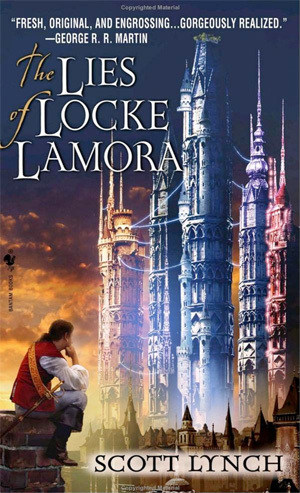
Review: The Lies of Locke Lamora by Scott Lynch

Book review of Scott Lynch’s The Lies of Locke Lamora

The Lies of Locke Lamora

Let the sun shine down.  On the other hand, if its looking overcast, there’s always the Falselight.

The Lies of Locke Lamora is an action-packed romp through high-society, with characters masquerading as everything from the lowest low-life to the most regal dandy and everyone else in between.  With hints of the fast-paced nature of The Da Vinci Code, the book jacket describes it as one part Robin Hood and one part Ocean’s Eleven, and the tale more than lives up to this description.  This book has all the best of the thieving lifestyle, from scaling towers six stories high, to impersonations of city officials, to some really sticky fight scenes.  While the accessibility of this book will appeal to just about anyone, there are definitely a few moments that would be hard to swallow for a younger crowd. This is an extremely fast-paced action adventure, broken up by flashbacks that somehow don’t hinder the pace in any way but only heighten the anticipation of getting back to the main storyline.

Locke Lamora and his band of Gentleman Bastards roam the streets of Camorr, taking part in all kinds of fantastic city intrigue.  Its no wonder that the rights to the film have already been picked up by Warner Brothers.  There are so many good one-liners and situational scenes in this book, its hard to imagine it not translating to the big screen.

Lynch does an above average job of characterization with the different members of the band, as well as the other citizens and denizens of Camorr.  The hero Locke is anything but; he’s your average Joe, or at least he appears to be.  Not having above average physical qualities certainly can have its advantages when theiving is your main source of income in a major port city.  His supporting band of Gentleman Bastards are the cream of Camorr’s thieving crop.  The background of each character is painted nicely, with new aspects and details of their training surfacing throughout the novel.  While you come to love Locke and his band of thieves, the mob bosses (which Lynch refers to as “Capas”), and other various characters truly bring this novel to life.

The various escapades take place to the backdrop of the city of Camorr which is original as it is deadly.  From true beauty to obscene brothels, this book runs the gambit of city life.  Scenes range from the most miniscule, dingiest bar you could imagine to the grandest of the grand stages. From new takes on ancient Roman Colosseum-style fighting, to an intricate network of towers and lavish festivals, Lynch paints a vivid picture of an ancient (or modernly regressed?) city in its prime.

What really shines in Lamora’s first effort is his ability to constantly build up the sense that there’s absolutely no way Locke and his fellow thieves are going to be able to accomplish their current task at hand, only to have them weasel their way out, around, or straight through whatever seems to be in their way.  Coupled with fantastic dialogue, this is a one-two punch that can’t miss.  One scene in particular stands our where we find Locke is haggling with a store merchant.  Its simply some of the best fast-paced dialog I’ve read in years.  Lynch captures moments like I’ve never read on paper.  They range from the intense:

Let’s start wobbling, shall we? said Locke’s knees, but this offer was met by a counterproposal from his better judgment to simply freeze up and do nothing, like a man treading water who sees a tall black fin coming straight at him.

To the just plain hilarious:

“What?” Sofia squeaked like a girl of eight.  A particularly squeaky girl of eight, much accustomed to squeaking, loudly.

Note to self: Use the same word three times in two sentences the next time I’m trying to be funny.

Rarely does a novel come along that is as brilliantly woven as Scott Lynch’s first venture into the fantasy genre.  The Lies of Locke Lamora truly sings a sweet symphony of subterfuge.  I have to say that this is the most complete action fantasy novel I have ever read.  It will be interesting to see where Lynch takes it for the next six novels.  If there are as many twists and turns as he’s delivered in his first book, this is one reader who will be back to join the Gentleman Bastards on many, many adventures to come.

You can purchase The Lies of Locke Lamora over at Amazon.com.

Fantasy Book News Ratings

  • Overall: 8 out of 10
  • Plot Originality
  • Setting Development
  • Characterization
  • Dialog
  • Pace

Fan Ratings

Interview with Scott Lynch on The Lies of Locke Lamora

Categories: Reviews, Scott Lynch, The Gentleman Bastards Cycle | Tags: , , , | 2 Comments