Reviews

Review: Red Seas Under Red Skies by Scott Lynch

Book review of Scott Lynch’s Red Seas Under Red Skies

Red Seas Under Red Skies

Lynch’s debut as a fantasy novelist made some waves in the industry, and his sequel had a big name to live up to. This is not just accomplished with Red Seas Under Red Skies. This time, the stakes are higher. I gave The Lies of Locke Lamora 8 out of 10 stars; it was a very quality debut. Lynch has managed to out-do himself with Red Seas Under Red Skies. I believe Lynch is defining a new genre: action fantasy. Sure, there are plenty of other action novels out there, and Lynch’s fantasy books remind the reader of such other great page-turners as Dan Brown’s works. The difference is that Lynch’s novels are huge – Red Seas Under Red Skies in paperback is just over 760 pages. Lynch’s ability to pack over 700 pages with non-stop page turning action is simply unmatched.

Red Seas Under Red Skies has all the elements you would expect from a great action novel: gambling, fighting, and pirates. I’m actually not sure what else I’d add if I had the option. Both Locke and Jean are back, this time moving their thievery to another city, after taking Camorr for all it was worth. The book moves from a deviously named casino, the Sinspire, to the complex of the Archon, general of the city of Tal Verrar’s military, out to the open seas where we find our two main characters impersonating yet another duo, this time a captain and his first mate.

The dialog is great. Lynch has a special ability with business transactions, when one character tries to haggle the price of an item with another. There was a great passage in The Lies of Locke Lamora that I didn’t note; luckily I noted the page when I found another such argument over purchasing pears in Red Seas Under Red Skies:

“A full volani?” Locke feigned outrage. “Not if the archon’s favorite whore held them between her legs and wiggled for me. One centira is too much for the lot.”

“One centira wouldn’t buy you the stems. At least I won’t lose money for four.”

“It would be an act of supreme pity,” said Locke, “for me to give you two. Fortunately for you I’m brimming with largesse; the bounty is yours.”

“Two would be an insult to the men and women who grew these, in the hot glass gardens of the Blackhands Crescent. But surely we can meet at three?”

“Three,” said Locke with a smile. “I have never been robbed in Tal Verrar before but I’m just hungry enough to allow you the honor.”

I don’t even really need to discuss the pace of this novel. Its action, at its best. Here you’ll find Locke and Jean impersonating nobles and gaming against terribly attractive women in some of the most high-stakes card games you’ve ever seen. You’ll discover plots against the government and the private sector, pitting them against one another. You’ll come across insane sea adventures, creatures that lurk just under the surface of the ocean, strange voices that call to you from the water, and death-defying leaps from cliffs and the tallest buildings in the city. In other words, it moves.

Naturally, the fast paced nature of such a novel comes with an outstanding serving of captured moments, like this:

The first notion Jean had that the floor had opened up beneath his feet was when the view of Tal Verrar suddenly seemed to move up toward the ceiling; his senses conferred hastily on just what this meant, and were stumped for a split second until his stomach weighed in with nauseous confirmation that the view wasn’t doing the moving.

and this classic:

It seemed to Locke that sweat was now cascading down his face, as though his own treacherous moisture were abandoning the premises before anything worse happened.

Combined with Lynch’s ability to conjure up imagery via delicious description:

As she flew past, Jean—his rope work quite forgotten—felt his stomach flutter. She had it. She wore it like a cloak. The same aura that he’d once seen in Capa Barsavi, something that slept inside until it was drawn out by anger or need, so sudden and so terrible. Death itself was beating tread upon the ship’s planks.

and you’ve got a knockout combination for some of the most in-your-face action fantasy that I’ve ever read.

The cast of characters in Red Seas Under Red Skies is fantastic. Not only are Locke and Jean back, but we’re introduced to a daring couple, heads of the Sinspire, Requin and his lover Selendri, a woman who’s face and arm are half covered in brass due to burn marks. The other large new character is Maxilian Stragos, the Archon of Tal Verrar. He’s surrounded by his “Eyes”, super efficient guards who wear full brass masks. And finally, you’ll get to meet Zamira Drakasha, captain of the Poison Orchid, and her first mate, Erzi Delmastro; two strong female characters who rule their ocean domain. In the background are the Bondsmagi, still upset for what Locke and Jean did to one of their own in The Lies of Locke Lamora. And as usual, you’ll find Locke and Jean taking on so many personas you’ll wonder how they keep them straight.

Red Seas Under Red Skies is a fantastic addition to the Gentlemen Bastards Cycle, and anyone who is a fan of either epic fantasy or action films should grab both Red Seas Under Red Skies and The Lies of Locke Lamora soon, so you can catch up before The Republic of Thieves is released in 2010.

You can pick up Red Seas Under Red Skies over at Amazon.com.
Fantasy Book News Ratings

  • Overall: 9 out of 10
  • Plot Originality
  • Setting Development
  • Characterization
  • Dialog
  • Pace

Fan Ratings

Categories: Reviews, Scott Lynch, The Gentleman Bastards Cycle | Tags: , , , , , | 2 Comments

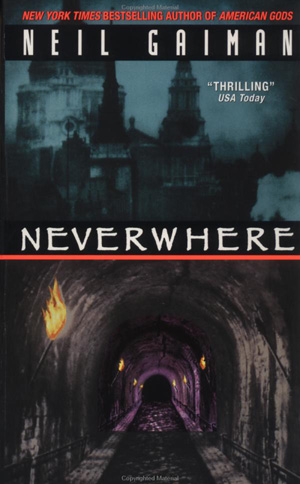
Review: Neverwhere by Neil Gaiman

Book review of Neil Gaiman’s Neverwhere

Neverwhere

It can be tough reviewing a book that has been turned into a movie or tv series. Luckily, I’ve never seen the Neverwhere tv series, so this review isn’t influenced by images of characters painted on screen, rather than in my head. Neil Gaiman is possibly most well known for his work on The Sandman graphic novel series. Neverwhere is his first solo novel, although he co-authored a book in 1990 with fantasy author Terry Pratchett. I’m not actually sure which came first, the tv series or the novel for Neverwhere; they were both released at the same time in 1996. I haven’t read his Sandman comics, but I had high hopes coming into reading Neverwhere, based solely on the popularity of the comic series.

Neverwhere presents a wonderful world where the line between reality and a sort of subterranean alter-reality blur. The book’s main character, Richard Mayhew, works in an office, is engaged, and is basically an average guy. It is this premise that the novel toys with; the drudgery of living out a mundane life of 9 to 5 office work, starkly contrasted with a world where rats are supreme beings, a fantastic moving marketplace can be held at night in strange city locations, and the scenes shift from strange trains in the London underground to hobos making their abode on the rooftops of skyscrapers.

The cast of characters is as entertaining as it is eccentric. Richard and Door, the other main character, are constantly pursued by a pair of classic baddies: Mr. Croup and Mr. Vandemar. They are protected by Hunter, a fierce female bodyguard, and are involved with The Angel Islington, an angel that in one scene serves them possibly the most potent wine in all creation. This is just the upper echelon of characters; there are plenty of well fleshed out supporting characters.

The characters in this alter-reality are not typically able to be seen by people living in the real world. They can get their attention if they try hard enough, but even when they accomplish this feat the people in the real world tend to forget they exist in a heartbeat; its like they don’t exist. There is a wonderful scene where Richard and Door attend an art gallery, as it is the entrance to the path that leads to The Angel Islington, and Richard’s finance is at the gallery, organizing an event for her company. The idea of individuals that exist in a world parallel to our reality, but seem to be just out of reach is painted vividly here.

Gaiman’s prose is like devilish poetry at times:

The carriage smelled like a morgue might at the end of a long, hot summer during the course of which the refrigeration equipment had failed for good.

and just plain hilarious at others:

Ruislip, the Fop’s opponent, resembled a bad dream one might have if one fell asleep watching Sumo wrestling with a Bob Marley record playing in the background. He was a huge Rastafarian who looked nothing so much as an obese and enormous baby.

Neverwhere is an original world, with a host of original characters and an extremely satisfying ending. Neil Gaiman’s ability to create a world that seems just out of reach is incredible, and he offers a bit of fantasy that just about anyone will identify with. This is a wonderful novel for fantasy fans; those with a healthy library of urban fantasy or those just tasting the genre for the first time.

You can pick up Neverwhere over at Amazon.com.

Fantasy Book News Ratings

  • Overall: 8 out of 10
  • Plot Originality
  • Setting Development
  • Characterization
  • Dialog
  • Pace

Fan Ratings

Categories: Neil Gaiman, Reviews | Tags: , , , , , , , , | 1 Comment

Review: Storm Front by Jim Butcher

Book review of Jim Butcher’s Storm Front

storm-front

Urban fantasy is on fire. Over the past two years, it seems that all you hear about in the fantasy book arena is how urban fantasy is taking over the genre. I’ve traditionally been more of an epic fantasy fan, but I decided to try my hand at a bit of urban fantasy. I flew through two books that seemed like good starting points for the genre: Storm Front by Jim Butcher and Neverwhere by Neil Gaiman. With the eleventh book in the series, Turn Coat, released in 2009, Jim Butcher’s series The Dresden Files is wildly popular, and has been recommended to me by a few friends. Neverwhere is Gaiman’s first novel, after years of fame coming from his Sandman comic book series. Both weigh in a little over 300 pages, and I flew through both. I’ll give my take of Storm Front here, and be sure that a Neverwhere review is coming soon.

I have to say that urban fantasy overall is a nice break from the doorstops I typically consume. Storm Front is not my first urban fantasy, having read  Angels & Demons and The Da Vinci Code years ago.

Butcher possesses great skill with description:

The house is full of creaks and sighs and settling boards, and time and lives have worn their impressions into the wood and brick. I can hear all the sounds, all the character of the place, above and around me all through the night. It’s an old place, but it sings in the darkness and is, in its own quirky little way, alive. Its home.

a bit of a comic perspective:

She was driving me crazy. That voice of hers inspired the kind of dreams you wish you could remember more clearly in the morning. Her expression promised to show me things that you don’t talk about with other people, if I would give her half a chance. Your job, Harry. Think about your job. Some days I really hate my job.

as well as the ability to truly inspire self-doubt in his characters:

Have you ever felt despair? Absolute hopelessness? Have you ever stood in the darkness and known, deep in your heart, in your spirit, that it was never, ever going to get better? That something had been lost, forever, and that it wasn’t coming back?

These different abilities shine through in a novel that is written with direct speech, similar to The Gunslinger by Stephen King. His main character, Harry Dresden, is a likable guy; he’s just a regular working class dude. With a bit of magic on his side. Butcher is able to work magic into an urban setting in a believable manner, although I think the originality of the magic system in Mistborn still remains on top. The magic system relies on different ingredients, partially on the weather, and partially on the random mix of items that, suggested by Harry’s talking skull, go into his different potions.

Harry gets himself into all kinds of predicaments, and this novel moves along at a brisk pace. Here you’ll find more action than much else, although I wouldn’t classify this as a 100% action novel. There are a number of great supporting cast members here, from Murphy, the woman on the police force who calls in Harry for different case work, to a sword-wielding sorcerer who is the enforcer of the White Council’s (the governing body of magic) rules. In addition, we see a number of great baddies, from giant scorpions to squat demons, and even a few mob thugs mixed in for good measure.

Storm Front is a very entertaining urban fantasy, and a great start to The Dresden Files series. Harry Dresden is a real character; you feel for him. He goes down to the corner bar when he needs to work out a few issues, and has to work a nine to five just to pay his rent. I should mention that although the novel itself is light and a very quick read, it definitely contains adult subject matter. If you’re looking for a novel where you can identify with any of these aspects, with a bit of crime-solving action thrown into the mix, then Storm Front is definitely for you.

You can pick up Storm Front over at Amazon.com.

Fantasy Book News Ratings

  • Overall: 7 out of 10
  • Plot Originality
  • Setting Development
  • Characterization
  • Dialog
  • Pace

Fan Ratings

Categories: Jim Butcher, Reviews, The Dresden Files | Tags: , , , , | 3 Comments

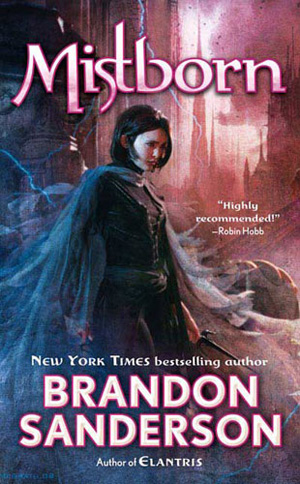
Review: Mistborn by Brandon Sanderson

Book review of Brandon Sanderson’s Mistborn

mistborn

Mistborn has been getting quite a bit of publicity recently, and came highly recommended to me by a close friend who has recommended other gems in the past such as Tigana by Guy Gavriel Kay. With Brandon Sanderson co-authoring the final novels in the Wheel of Time series due to the passing of Robert Jordan, its no wonder his earlier works would fall under scrutiny. While not his first fantasy novel, Mistborn: The Last Empire, commonly referred to as just Mistborn, is the first novel in a trilogy of novels titled the Mistborn Trilogy. The subsequent books are The Well of Ascension, and The Hero of Ages. I feel this needs a little clarification, as from reading the book jacket and inside covers, it can be rather confusing as to the order of the novels. For instance, the inside cover of my paperback edition lists three books: Elantris, Mistborn and The Well of Ascension, making it look like Mistborn is the middle book in a trilogy. Also, the preview chapter at the end of the book is from The Hero of Ages, book three in the series, leading to more confusion. Maybe Tor should reevaluate for subsequent editions.

The novel takes place mainly in the city of Luthtadel and the lands surrounding it. Luthtadel is a city harshly divided into an upper and lower class; a government rules with an iron fist over the nobility and the lower class “skaa”. Sanderson deals masterfully with the theme of ruling governmental bodies, the politics both within that ruling body and their relationships with external parties. Mirroring this are the novel’s main themes of belief, trust, and hope that live in the spirit of the lower class. We find these themes recurring frequently throughout the novel.  Here are a few samples:

“Belief isn’t simply a thing for fair times and bright days, I think. What is belief – what is faith – if you don’t continue in it after failure?”

“Once, maybe I would have thought you a fool, but…well, that’s kind of what trust is, isn’t it?  A willful self-delusion?  You have to shut out that voice that whispers about betrayal, and just hope that your friends aren’t going to hurt you.”

A good portion of the action in the novel takes place in the houses of the nobility, throwing balls which are attended by the nobility and overseen by the royal “obligators”.  Other scenes include the palace of the Lord Ruler, the hideouts of the rebel skaa located throughout the city, and at night, when the entire city stays indoors and mist blankets the city.

The characters that make up Mistborn’s band of rebel skaa are unforgettable.  Vin and Kelsier take center stage, with Marsh, Kelsier’s brother, and Kelsier’s assembled crew fleshing out the rest of the group.  When the rest of Kelsier’s group is first introduced, I felt like I was reading a fantasy novel spiced with great characters from the world of comic books, each having their own special power.  The difference with Sanderson’s Mistborn characters, and many of the characters I read about in my childhood in comics, are that Sanderson’s are believable.  The system of magic created in Mistborn is unsurpassed in its impressive originality and astounding authenticity.  It makes you feel like the 40-foot-high jumps and acrobatic maneuvers from games like Assassin’s Creed are real; they have real consequenses if the user of the magic does not know enough about it, or miscalculates to a small degree.  It also has limits.  If the user of the magic “burns” up his or her resource, they have no more.  I won’t get into too much more detail, of which there is plenty, but suffice to say the magic system in Mistborn is a true gem.

Sanderson moves the plot of Mistborn along at a pace perfect for the unfolding story.  While there are a lot of scenes that recur in a similar setting (the balls), there is always enough new story, whether its the character Vin learning about the politics taking place, or just plain action, the time spent in these pages is well worth it.  The plot idea of a band of underground thieves working against the nobility brings Scott Lynch’s The Lies of Locke Lamora to mind, and the overarching theme of overthrowing an all-powerful being has definitely been done before.

Mistborn is an extremely satisfying stand-alone novel, even though its only the first in a trilogy.  If you haven’t read any of Sanderson’s work, I would highly recommend you go out and pick up Mistborn.  Action-packed, with great underlying themes and a rowdy bunch of characters with truly original powers, this is certainly not one to miss.

You can pick up Mistborn over at Amazon.com.

Fantasy Book News Ratings

  • Overall: 8 out of 10
  • Plot Originality
  • Setting Development
  • Characterization
  • Dialog
  • Pace

Fan Ratings

Categories: Brandon Sanderson, Reviews, The Mistborn Trilogy | Tags: , , , , , , , , , , | 7 Comments

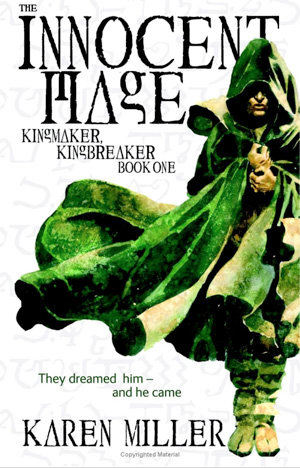
Review: The Innocent Mage by Karen Miller

Book review of Karen Miller’s The Innocent Mage

the-innocent-mage

I really didn’t know what to expect leading up to reading The Innocent Mage by Karen Miller.  I’d seen some recent publicity for The Prodigal Mage, and it seemed to be making a bit more noise than the first two Kingmaker, Kingbreaker books.  I admittedly picked up the book on a whim, perusing the options at my local bookstore, and honestly chose the book by its cover.  Probably the last time I’ll ever make that mistake.  The Innocent Mage is as bland as a stale unsalted Saltine.  I knew I was in trouble by the fifth sentence, which is usually the kiss of literary death:

Holding his breath, he slid out of his old, creaking bed and put his bare feet on the floor as lightly as the rising sun kissed the mouth of Restharven Harbor.

I don’t know about you, but I like my analogy to reference something that I’m familiar with, giving me a more clear picture of the idea the author is attempting to paint.  Comparing the stealth with which a character leaves his bed with the mouth of a fictional body of water that hasn’t been described yet not only doesn’t improve my understanding, it actually makes it less clear.  This is one example of the vast quantity of paper-thin attempts at quality writing in The Innocent Mage.

After about 50 pages or so of non-plot advancing description, dry dialog, and a general feeling that you want to go hang yourself, we’re presented with this gem:

I am Jervale’s Heir and I know. Asher is the Innocent Mage. The Final Days are coming. And I am the last living of Jervale’s descendants, born to guide our ignorant fisherman to victory…or fail, and doom our world to death and despair.

What’s that?  You just threw up?  That’s funny, I regurgitated a bit in my mouth the first time I read this too.  Not only is it the same old story of good versus evil with the actions of the main character effecting the entire world, it is simply unreadable!  This is dialog at its worst.  People just don’t talk like this, it doesn’t feel natural, and it leads to rereading sections of a book that probably aren’t worth reading the first time.

Warning: spoilers to follow.  Then again, it probably doesn’t matter since after this review you likely won’t be rushing out to pick up The Innocent Mage any time soon.

Just as Miller feels like she’s going to take the opportunity to advance the plot, or do something exciting with the characters, you find yourself slogging through an entire chapter of the characters crying over miniscule issues from previous chapters.  There’s a beheading scene that makes the main character Asher queasy, and he whines about it for chapter upon chapter to follow.  I compared this with the beheading from A Game of Thrones, seen randomly from the distance by the eyes of the daughter of the man being beheaded.  Quick, meaningful, powerful, and classic.  None of these qualities exist in Miller’s The Innocent Mage.

The rest of this 600+ page novel continues in the same dull fashion, with one of the high points coming when the all-powerful evil being takes over the body of the king’s mage.  Unfortunately, this also is handled terribly.  The narration switches to the viewpoint of the omniscient evil being.  I don’t know about you, but my familiarity with the point of view of an omniscient being is pretty scarce.  The way to play this would have been to have the evil being take over the mage, but view the oddities and transformation from the outside, rather than trying to give the reader an insight into the mind of an omniscient character, and failing miserably.

The novel concludes without resolving anything, and the author throws most of her main characters off a cliff.  I’d recommend that if you come across a copy of The Innocent Mage, you do the same.

Its safe to say I’ll be avoiding anything by Karen Miller for the foreseeable future.  I’m giving it two stars: one for the decent jousting scene about halfway through, and one for any aspiring author who wants to pick up a novel chock full of examples of what not to do.

Take your chances with The Innocent Mage over at Amazon.com.

Fantasy Book News Ratings

  • Overall: 2 out of 10
  • Plot Originality
  • Setting Development
  • Characterization
  • Dialog
  • Pace

Fan Ratings

Categories: Karen Miller, Reviews | Tags: , , , | 10 Comments

Review: The Gunslinger by Stephen King

Book review of Stephen King’s The Gunslinger

the-gunslinger

If there’s one thing I try to do here at FantasyBookNews.com when I review books, it is to give an honest assessment of books, without being swayed too heavily by who the author is, how famous the series may be, or any other outside influences.  A novelist as big as Stephen King is hard to ignore, and treat in this manner.  I mean, the guy’s written countless novels that have made the extremely difficult trip from page to screen, and had actors the caliber of Jack Nicholson bring some of his characters to life.  This is my first Stephen King novel.  I’ve never really dipped to deep into the horror genre, but The Gunslinger is supposed to be King’s adventure into the fantasy genre.  He makes numerous mentions of Tolkien, hobbits, and the other fantasy genre novelists that followed Tolkien’s lead in the introduction to The Gunslinger.  I should also mention that I’m currently listening to King’s On Writing audiobook, which is a fantastic read for any aspiring writer.  In it, King details all aspects of writing, in particular his personal style of of not really planning the plot of his books prior to writing them.  I can’t say that I didn’t have this thought in mind while I was reading The Gunslinger.

While King set out to write an epic fantasy, he decided he’d leave the elves, dragons and hobbits to the countless other authors who have attempted to recreate the experience that was Tolkien’s original classic.  The setting for The Gunslinger is that of a western adventure.  It has a quest feel to it, and you can’t help but notice the similarity with “The Dark Tower” to Tolkien’s tower of Sauron.  The Gunslinger is a great character, well developed, with a very raw edge to him. King’s other characters in this novel are very well fleshed out, although we don’t get to see much of the Man in Black as I would have liked.  The settings are quality, with a mixture of desert scenes and almost surreal experiences that the Gunslinger goes through.  Its an interesting landscape, as while the tangible elements, like surroundings, buildings, and characters all seem to suggest early 1900’s western, it appears as if the novel actually takes place in a regressed future.

The story follows the current timeline of the Gunslinger, interspersed with flashback scenes of the Gunslinger’s childhood and coming of age.  While both stories keep the pages turning, I don’t feel they had enough that eventually intertwined them.  I would have like more from Roland’s past to have potentially adverse affects on his future, or other creative use of the flashback story line.

All things said, I can honestly say that I was tremendously underwhelmed by The Gunslinger.  I’ve read the comics by Marvel, and I really believe this novel reads better as a comic or graphic novel than a book.  It may have to do with the fact that The Gunslinger is actually five short stories originally written for The Magazine of Fantasy and Science Fiction in the ’70s.  It may have had to do with the fact that I was studying King’s writing methods simultaneously, and was overcritical of  the plot and where I felt the book was actually going.  That said, I think I’ll definitely be back to see where King actually takes this series.  It is a seven book series, with the first four being published with an average of five years between each, and the last three being published over the span of two years.  I may just be curious to see if King went on a Kerouac-esque writing binge to finish the final three novels.

I think King could have taken this character and accomplished a lot more with him over the course of The Gunslinger, but I’m definitely interested in seeing where The Gunslinger eventually ends up.  I’ll do my homework and keep everyone posted.

You can purchase The Gunslinger over at Amazon.com.

Fantasy Book News Ratings

  • Overall: 4 out of 10
  • Plot Originality
  • Setting Development
  • Characterization
  • Dialog
  • Pace

Fan Ratings

Categories: Reviews, Stephen King, The Dark Tower | Tags: , , , , | Leave a comment

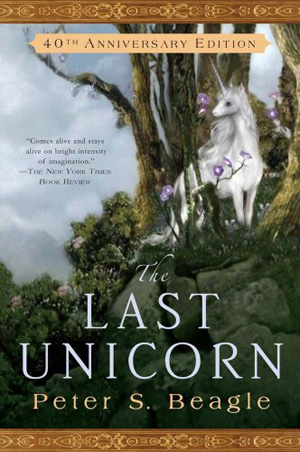
Review: The Last Unicorn by Peter S. Beagle

Book review of Peter S. Beagle’s The Last Unicorn

the-last-unicorn

In my last review of Ship of Magic, I mentioned how I was going to take a departure from the more grown-up world of fantasy for a quick stop on the young adult shelf.  The Last Unicorn, while a shorter novel, is not what I could classify as a light read.  This is a fairy tale, but a satire about fairy tales, with strong undercurrents of truth strewn throughout.  I had considered picking it up in the past, but was discouraged by the fact that there was a unicorn on the cover.  Never, and I mean never, judge a book by its cover.  It make take some a while to become comfortable with what others may judge of reading such a novel.  All I have to say to that is, get over it.  This book is fantastic, beautiful, magical, and hilarious.  If you’re not into that type of stuff, then I’d recommend you go elsewhere.  If you’re into completely absorbing fantasy, and are in for a change of pace from the hulking epic fantasies that are commonplace these days, then I invite you to read The Last Unicorn.

Being a fairy tale, the novel takes place in a few fantastic settings.  The landscape can seem to stretch and contract as Beagle moves from one scene to the next, but it is the locations and characters that truly anchor this novel to reality, which is a tough thing to do when you have a cat that can blink into existence out of a fold in the air.  In this sense, the novel shows some similarity with Alice in Wonderland.  The irony comes in when the characters themselves acknowledge that they are in a fairy tale, speaking of what heroes and magicians are or should be, and how happy endings should actually end.  All of this is accomplished masterfully, with real meaning hiding just under the surface.  I can perhaps best illustrate with example:

“Robin Hood is a myth,” Captain Cully said nervously, “a classic example of the heroic folk figures synthesized out of need.  John Henry is another.  Men have to have heroes, and so a legend grows around a grain of truth, like a pearl.  Not that it isn’t a remarkable trick, of course.”

Captain Cully, leader of the band of merry men that is undoubtedly a parody of Robin Hood and his merry men, speaking plainly of the mythology of Robin Hood, but delivered with a clear insight into the fact that we as a society like to have people to look up to and uphold as idols.  Brilliant!  The Last Unicorn is full of wonderful moments like this.

The characters in this novel are classic.  From Prince Lir, a character based on Irish mythology, to Schmendrick, a bumbling magician who always seems to have the words to his spells on the tip of his tongue, these characters feel right.  They all have their place in the novel, and while not overly developed, they all serve their own purpose perfectly.

Peter S. Beagle uses so many classic examples of fairy tale plots, I don’t believe it possible to detail them all here.  What is worth mentioning, is how they are spun uniquely into a new yarn, woven with precision and intent, with the final product bearing signs of originality you wouldn’t  have previously believed possible.

The pace is quick.  The chapters are light, and I would definitely recommend this book for a younger audience, although it is just as enjoyable at an adult reading level, even refreshing in a sense.

The Last Unicorn is, in a word, delightful.  If you have yet to read this classic fantasy fairy tale, I would highly recommend you give it a shot.  You may be in for a few surprises.

You can purchase The Last Unicorn over at Amazon.com.

Fantasy Book News Ratings

  • Overall: 9 out of 10
  • Plot Originality
  • Setting Development
  • Characterization
  • Dialog
  • Pace

Fan Ratings

Categories: Peter S. Beagle, Reviews | Tags: , , , , , | 2 Comments

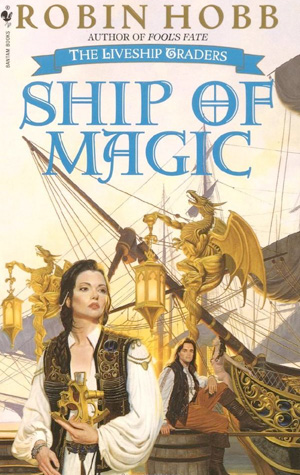
Review: Ship of Magic by Robin Hobb

Book review of Robin Hobb’s Ship of Magic

Ship of Magic by Robin Hobb

Ship of Magic made my list originally as a recommendation by George R.R. Martin on his “Not a Blog” where he listed a bunch of authors to enjoy while awaiting the release of the fifth novel in the Song of Ice & Fire series, A Dance with Dragons.  We’re still waiting, and I’m still reading recommended books off his list.  I’m glad to say, that with Ship of Magic by Robin Hobb, I’ve been turned on to a fantastic author I had not previously read.  My initial impression was, like I’m sure a lot of first impressions about Ship of Magic are, that the author would have to pull off something really special in order for me to believe a book about talking ships.  Ship of Magic offers a completely unique and original idea (something pretty hard to come by in fantasy fiction these days), and delivers it in a way that is not only believable, but really cuts straight to the deeper topic of relationships.

These characters are believable.  Tough for some authors to accomplish with humans, Hobb takes typically inanimate objects and breaths life into them.  Life that is similar in some ways to human, but is intricate in its subtle differences.  The variety of characters is enjoyable, and Hobb takes the perspective of the few main characters (including non-humans), as well as some of the secondary characters, which creates an enjoyable blend of viewpoints.  Not as vast as some of George R.R. Martin’s works, where he can go for entire novels skipping characters, Hobb’s cast of characters is a wonderful balance.  Some of my favorite insights came from the character Wintrow, a teenage Priest of Sa in training, and his teacher’s lessons:

“Wintrow,” he chided softly.  “Refuse the anxiety.  When you borrow trouble against what might be, you neglect the moment you have now to enjoy.  The man who worries about what will next be happening to him loses this moment in dread of the next, and poisons the next with pre-judgement.”

Or his conversations with Vivacia, the Vestrit family liveship:

“This is blasphemy,” Wintrow said fervently.

“Is it?  Then how do you explain it?  All the ugliness and viciousness that is the province of humanity, whence comes it?”

“Not from Sa.  From ignorance of Sa.  From separation from Sa.  Time and again I have seen children brought to the monastery, boys and girls with not hint as to why they are there.  Angry and afraid, many of them, at being sent forth from their homes at such a tender age.  Within weeks, they blossom, they open to Sa’s light and glory.  In every single child, there is at least a spark of it.  Not all stay; some are sent home, not all are suited to a life of service.  But all of them are suited to being creations of light and thought and love.  All of them.”

“Mm,” the ship mused.  “Wintrow, it is good to hear you speak as yourself again.”

Hobb does a fantastic job of moving the point of view from a young, frivolous, barely thirteen year old girl, to her grandmother, the matriarch of the family.  There is a healthy cast of pirates, and a few quintessential pirate novel plot points that I won’t get into in this review.

Moving from one character to the next gives the novel a dextrous pace, with the reader never feeling the need to progress the story at either a slower or quicker speed.  The book mainly takes place in port towns, or on the open sea.  The characters range from once-wealthy families who own liveships, to a great mixture of pirates and sea serpents, to a mysterious society of folk who live up the Rain Wild river.  Hobb has actually focused on this society of people for her most recent series, The Rain Wild Chronicles, the first novel of which, Dragon Keeper, was recently released in the UK, and is slated for release in the US in January 2010.  I’d recommend starting with the Liveship Traders books, and working your way to toward the new series.
Ship of Magic is definitely an adult novel, with multiple adult-oriented themes running through it, so reader beware.  I’m going to take a break from this genre with my next read, The Last Unicorn by Peter S. Beagle.

To be able to take an idea as far fetched as living ships (and other wooden objects) and pull it off as well as Hobb does truly is a testament to her talent for writing creative fantasy literature.  The flair with which she builds the characters and world around this central idea in Ship of Magic is the cement in a foundation of an expanding mansion epic fantasy novels.  I would highly recommend Ship of Magic as a starting point to Hobb’s world of fantasy books.

You can purchase Ship of Magic over at Amazon.com.

Fantasy Book News Ratings

  • Overall: 8 out of 10
  • Plot Originality
  • Setting Development
  • Characterization
  • Dialog
  • Pace

Fan Ratings

Categories: Reviews, Robin Hobb, The Liveship Traders | Tags: , , , , , , , | 3 Comments

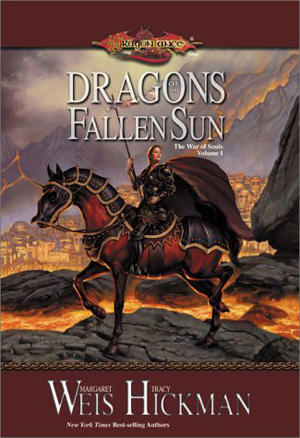
Review: Dragons of a Fallen Sun by Margaret Weis & Tracy Hickman

Book review of Weis & Hickman’s Dragons of a Fallen Sun

Dragons of a Fallen Sun by Margaret Weis and Tracy Hickman

Ah, Dragonlance.  Dragons of Autumn Twilight was one of the very first non-choose-your-own-adventure-style novels I read, dating back to my pre-teen years.  I’ve still got the original first printing paperback.  Simply classic.  Returning to Krynn is always a fun time for me, having read a healthy dose of Dragonlance in my life.  I’ve made my way through the original Chronicles trilogy, the original Legends trilogy, Dragons of Summer Flame, The Dawning of a New Age, and more recently Dragons of the Dwarven Depths.  I definitely dabbled in a few spin-offs as well, like Galen Benighted and the Preludes II books.  The first six books I’ve read multiple times.  So coming back to Krynn is always a bit nostalgic for me, but with that out of the way I can say I’ll be as fair as I can with this review.

For anyone who knows the Dragonlance world, Dragons of a Fallen Sun will be a welcome return.  Everything you’re familiar with is here, from the non-human cast of elves, dwarves, kender, gnomes, draconians, minotaurs and the like to the warm feeling you’ll get when you return to Solace.  The settings are some of the most well-known and well developed in fantasy books, and range from large cities to open plains to the underground tunnels of the dwarves and the forested protection of the elven lands.

Dragonlance novels are undeniably high fantasy.  Dragons of a Fallen Sun is no different.  You’ve got a fairly standard cast of rebel elves, conquesting dark knights, and mischievous kender.  One of the main differences between this novel and the previous Dragonlance novels I’ve read is the presence of dragons.  Dragons are seen in other Dragonlance novels, but they way in which they are presented as rulers over certain regions of Krynn in Dragons of a Fallen Sun differs from their typical appearances and presence in Krynn.

The novel moves fairly quickly, although one caveat I noticed is that at the beginning of a lot of the chapters, we’re reminded frequently of what the other characters are doing at that very moment.  I personally don’t feel the need to be reminded continually of what else is going on in the novel.  If I do forget (which can happen easily in books like A Game of Thrones), I’m usually delighted to return to a character I had let slip from my focus.  Its actually a tool that some authors use to their advantage, and I felt that with Dragons of a Fallen Sun there was perhaps a bit of a “dumbing down” for mass audiences.  I’m not sure if this is something Weis and Hickman would inject into their story themselves, or if it is a ploy of the publisher to appeal to a larger market.  Either way, its there.

Even though this novel is set about 30 years in the future with respect to the original Weis and Hickman Dragonlance novels, they still manage to work three of the original eight characters from the Heroes of the Lance into the book.  Its a difficult task to do for any author, but Weis and Hickman accomplish it beautifully in a manner that is at times funny.

Overall, while I thoroughly enjoyed my return to Krynn, there has been some opinion in recent years that the quality of the Weis and Hickman novels has declined.  I had my first taste of this with Dragons of the Dwarven Depths, which is an even more recent book than Dragons of a Fallen Sun.  It seems to me that there is a lack of enthusiasm on the part of Weis and Hickman with the recent Dragonlance books, and I would skeptically mention that it could be caused by Wizards of the Coast’s takeover of the Dragonlance books and the entire AD&D brand.  Even though it brings me back to my childhood, I just can’t give high ratings to a book based on personal nostalgia, especially when it can’t compete with some of the other great fiction that’s out there right now from authors like Patrick Rothfuss, Scott Lynch, and Robin Hobb.

If you’re a Dragonlance fan, this book is definitely worth checking out, as there are a lot of familiar characters, settings, and stories.  If you’re just getting started with fantasy novels, but would like to test the Dragonlance waters, I would suggest you start at the beginning with Dragons of Autumn Twilight.

You can purchase Dragons of a Fallen Sun over at Amazon.com.

Ratings

  • Overall: 5 out of 10
  • Plot Originality
  • Setting Development
  • Characterization
  • Dialog
  • Pace
Categories: Dragonlance, Reviews, The War of Souls, Weis & Hickman | Tags: , , , , | 1 Comment

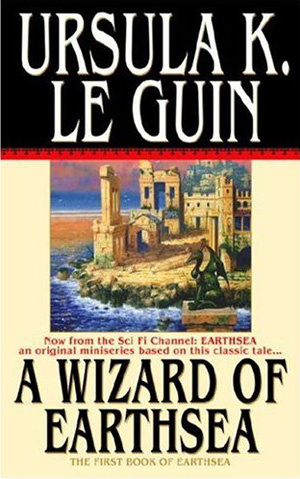
Review: A Wizard of Earthsea by Ursula K. Le Guin

Book review of Ursula K. Le Guin’s A Wizard of Earthsea

A Wizard of Earthsea by Ursula K. Le Guin

I was given this book on loan, thanks to my great friend Rachel, as she thought it would be a good book for me to travel with.  This was a very fitting selection, as the novel is filled with voyages into the unknown, the constant charting of new lands, and either chasing after, or running from, dreams or fears in life.

It was originally published in 1968, so I was expecting something akin to the style of The Sword in the Stone, which, even though it was written almost thirty years prior, in my mind seems to get lumped into a big ball of classics as does anything pre-1980.  What I was delighted to find with A Wizard of Earthsea was not only a similar writing style to The Sword in the Stone, but also to beat generation novels like Jack Kerouac’s On the Road and The Town and the City.  It seems that in the mid-nineteen hundreds a more free-form writing style was the popular practice, while today authors seem to take a much more refined, direct approach.  But enough on theory.

Earthsea is an ocean littered with islands, some of which disappear with the tides.  The people are wary of travelers, and what they know of the world consists of their understanding of their land, and the few stories they may have heard about other islands over the years, but even those seem distant dreams.  There is an average cast of characters here, and it should be noted that I found many similarities between this novel and some of the character and plot aspects of The Name of the Wind.  For instance, the main character goes to a school for wizards and meets who comes to be a rival on the first day of school.  The magic system is similar in that the characters who truly learn to master different aspects of wizardry do so by learning the true names of things.  Its really interesting to see how newer novels were influenced, sometimes more heavily than you realize, by some of the classic fantasy novels.

The pace of A Wizard of Earthsea is very brisk.  The author moves from once situation to the next, only dwelling long enough to cover the essentials, without any unnecessary filler or padding.  This makes for a very light novel (the paperback I have weighs in at 187 pages), one that does not set you down and give you a chance to rest.  This does not result in a lack of quality reflection time.  Le Guin covers everything from the responsibility that comes with great power:

Ged, listen to me now.  Have you never thought how danger must surround power as shadow does light?

to the intellectual contemplation of nature:

From that time forth he believed that the wise man is one who never sets himself apart from other living things, whether they have speech or not, and in later years he strove to learn what can be learned, in silence, from the eyes of animals, the flight of birds, the great slow gestures of trees.

It is this ability to balance a fast-paced story with the beauty of pondering some of the finer aspects of life that makes A Wizard of Earthsea truly shine.

The most prominent and meaningful aspect of A Wizard of Earthsea is the underlying theme of the main character in a constant battle with himself, and the stark contrast of either running from your problems, or turning to face them head-on.  It describes vividly how the way in which one decides to handle life issues can be either a blessing or turn into a disease.  It is this concept that I believe makes A Wizard of Earthsea as timeless as it is.  Just about anyone can relate to this sentiment on some level:

But as the day passed, his impatience turned from fear to a kind of glad fierceness.  At least he sought this danger of his own will; and the nearer he came to it the more sure he was that, for this time at least, for this hour perhaps before his death, he was free.

It this modern world we live in it can feel at times as though we are locked eternally into a struggle to get ahead, but the real joy and happiness is found when we live in the moment, and realize that we are free to enjoy the time we are given as we please.

A Wizard of Earthsea is truly a book deserving of the title “classic”, and has rightfully earned its place upon my bookshelf for years to come.  Or at least until I have to give it back.

You can purchase A Wizard of Earthsea over at Amazon.com.

Fantasy Book News Ratings

  • Overall: 7 out of 10
  • Plot Originality
  • Setting Development
  • Characterization
  • Dialog
  • Pace

Fan Ratings

Categories: Reviews, The Earthsea Trilogy, Ursula K. Le Guin | Tags: , , , , | 5 Comments